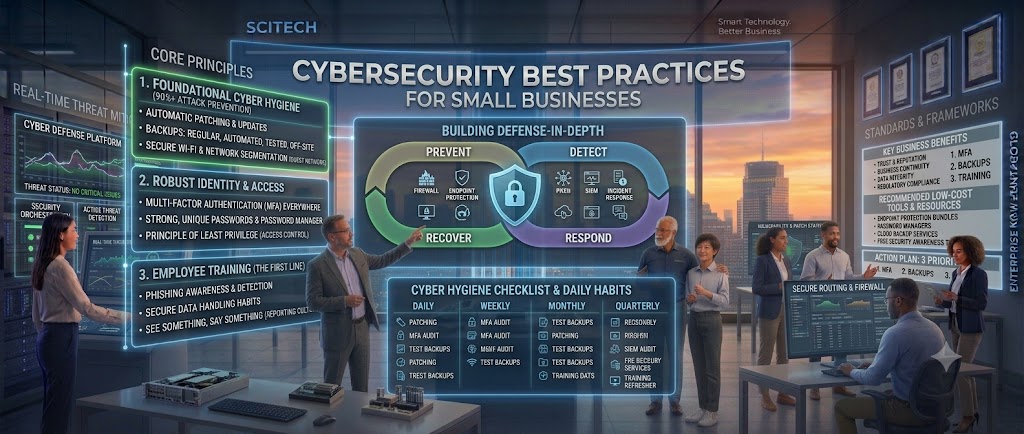
Cybersecurity Best Practices for Small Businesses
In today’s digital environment, cybersecurity is no longer only a concern for large enterprises. Small businesses are increasingly targeted by cybercriminals because they often have limited security resources while managing valuable customer information, financial data, and business systems.
At SCITECH IT SOLUTION PLC, we help small and medium-sized businesses strengthen their cybersecurity posture by implementing practical security measures that reduce risks, protect sensitive information, and ensure business continuity.
1. Use Strong Passwords and Multi-Factor Authentication (MFA)
Weak or reused passwords are among the most common causes of security breaches. Businesses should establish strong password practices and add an additional layer of protection through multi-factor authentication.
Best practices include:
Creating strong and unique passwords for each account
Using password management tools
Enabling MFA for email, cloud services, and business applications
Regularly reviewing user access permissions
2. Keep Software and Systems Updated
Cyber attackers often exploit outdated software vulnerabilities. Regular updates help protect systems against known security weaknesses.
Businesses should:
Install operating system updates regularly
Update business applications and software
Apply security patches promptly
Remove unused applications and services
3. Protect Business Data with Regular Backups
Data loss caused by ransomware, hardware failure, or accidental deletion can seriously affect business operations. A reliable backup strategy ensures important information can be recovered quickly.
Recommended practices:
Perform regular automated backups
Store backup copies in secure locations
Test backup restoration procedures
Protect backup systems from unauthorized access
4. Secure Your Network Infrastructure
A properly secured network helps prevent unauthorized access and protects business systems from external threats.
Important network security measures include:
Using enterprise-grade firewalls
Securing Wi-Fi networks with strong encryption
Separating guest and business networks
Monitoring network activity
Changing default device passwords
5. Train Employees on Cybersecurity Awareness
Employees are an important part of cybersecurity. Many attacks begin with phishing emails, social engineering, or unsafe online behavior.
Security awareness training should cover:
Identifying phishing emails
Avoiding suspicious links and attachments
Protecting company information
Safe internet and email practices
Reporting security incidents
6. Install Endpoint Protection
Computers, laptops, and mobile devices connected to business systems must be protected against malware and unauthorized activities.
Businesses should implement:
Antivirus and anti-malware solutions
Endpoint Detection and Response (EDR)
Device security policies
Regular security scans
Mobile device protection
7. Control User Access
Not every employee needs access to all company systems and information. Proper access management reduces the risk of data exposure.
Best practices:
Apply role-based access control
Remove inactive user accounts
Limit administrator privileges
Review user permissions regularly
8. Protect Email and Online Communication
Email remains one of the most common channels for cyber attacks. Businesses should secure their communication platforms.
Security measures include:
Email filtering and spam protection
Anti-phishing solutions
Secure email configuration
Employee email security training
Domain protection measures
9. Develop an Incident Response Plan
Every business should be prepared to respond quickly when a security incident occurs.
An incident response plan should define:
How to identify security incidents
Who is responsible for response activities
Steps for containing threats
Data recovery procedures
Communication processes
10. Work with Cybersecurity Professionals
Small businesses may not have dedicated security teams, making professional support valuable for protecting their digital environment.
Cybersecurity service providers can assist with:
Security assessments
Vulnerability testing
Firewall configuration
Security monitoring
Compliance support
Incident response
Essential Cybersecurity Checklist for Small Businesses
✓ Enable Multi-Factor Authentication
✓ Use strong passwords
✓ Update software regularly
✓ Backup important business data
✓ Secure networks and devices
✓ Train employees about cyber threats
✓ Monitor systems for suspicious activities
✓ Limit access to sensitive information
✓ Prepare a recovery plan
Conclusion
Cybersecurity is an ongoing process that requires continuous attention, awareness, and improvement. By implementing the right security practices, small businesses can reduce cyber risks, protect valuable data, and build trust with customers.
SCITECH IT SOLUTION PLC provides practical cybersecurity solutions that help small and medium businesses build stronger, safer, and more resilient digital environments.
SCITECH IT Solutions
Technology Expert Team